Introduction
My name is Rashid Naimi.
My twitter user ID is a1call.
Telephone: (514) 945-7231
This document is not intended to be exhaustive, but rather to
describe a principle and initiate further discussion.
The
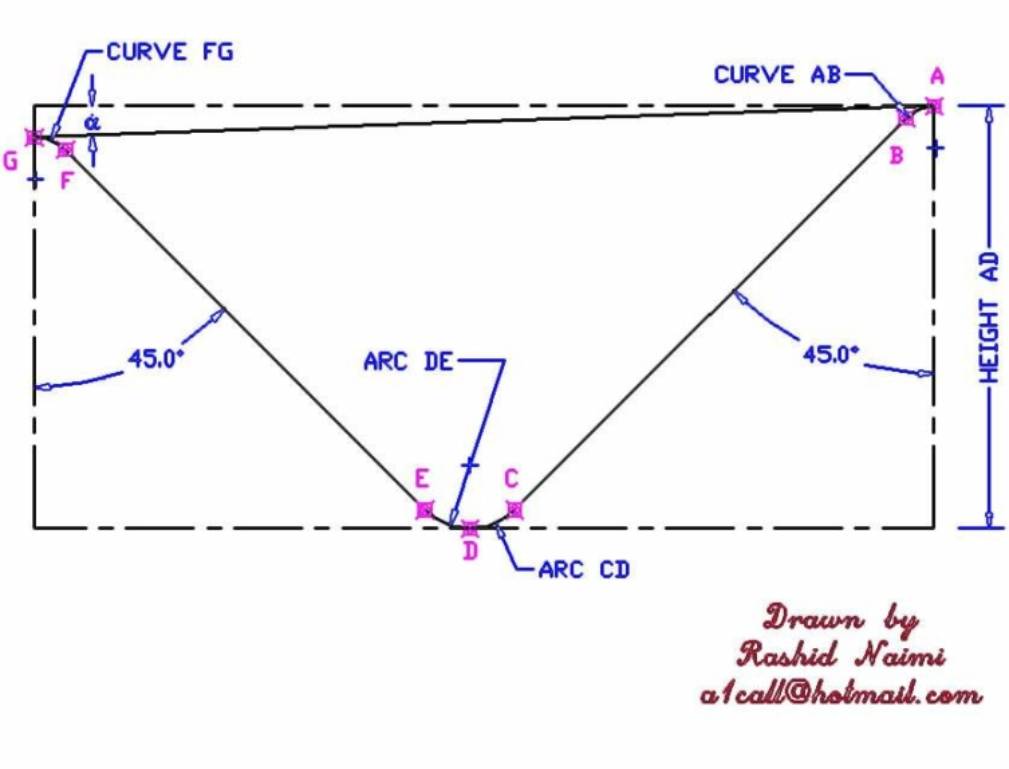
path ABCDEFG can be a faster path than the path AG
The curve AB is a parabolic curve equal to the path of free fall
at point A at the maximum expected initial velocity and point B is
where this curve is tangent to a 45° line.
The line BC makes a 45° angle with the normal and is tangent to the
curve AB.
The arc CD is a 45° arc and is tangent to the line BC, and it's a
radius is optimized by being as short as possible while respecting the
size of the vehicle and tolerances for the g forces during this part of
the path.
The arc DE is a 45° arc and is tangent to the arc CD and has the same
radius.
The line EF is tangent to the arc DE and makes a 45° angle to the
normal. It's length is a factor of the curve FG.
The curve FG is a parabolic curve and it is equal to the expected path
of a projectile at point F. It is tangent to the line EF.
It is also tangent to a line parallel to the line AG and in this case
is drawn tangent to the line AG.
The height AD is determined by factoring in available construction
techniques, drag, and available thrust among other factors.
The angle a is any feasible angle (generally
a<45°).
A numeric example
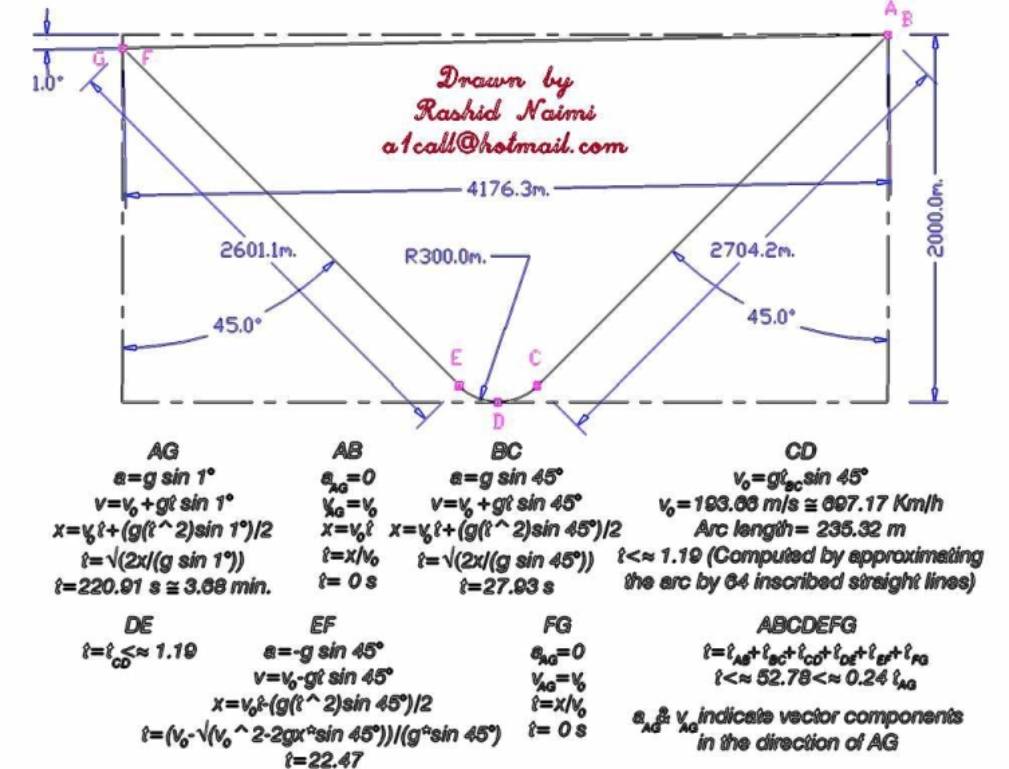
For the sake of simplicity, in the following example the curves AB and
FG are set to be of zero length. Also, it is assumed that there
is no drag and/or friction. In this example the path ABCDEFG is
more than four times faster than the path AG. The average speed along
the path AG is 68.06 km/h while the average speed along the path
ABCDEFG and in the direction AG is about and/more than 284.86 km/h.
The angle a
is set at 1°, only for the purpose of describing this principle and not
because a height difference at points A and G is required.
Considerations for drag and
friction
The exact calculations of drag and friction are beyond the scope of
this document at the present time. However, in my opinion the
following experiment proves that the principle can be true in the
presence of drag and friction.
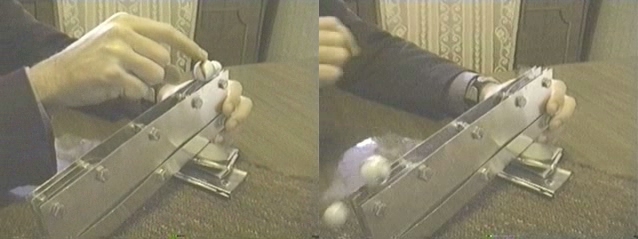
Please click on the video capture image below to see the experiment.
(The video has been slowed down for clarity).
Please note that depending on your computer, playing the clip a second
time might eliminate skipped frames if any.
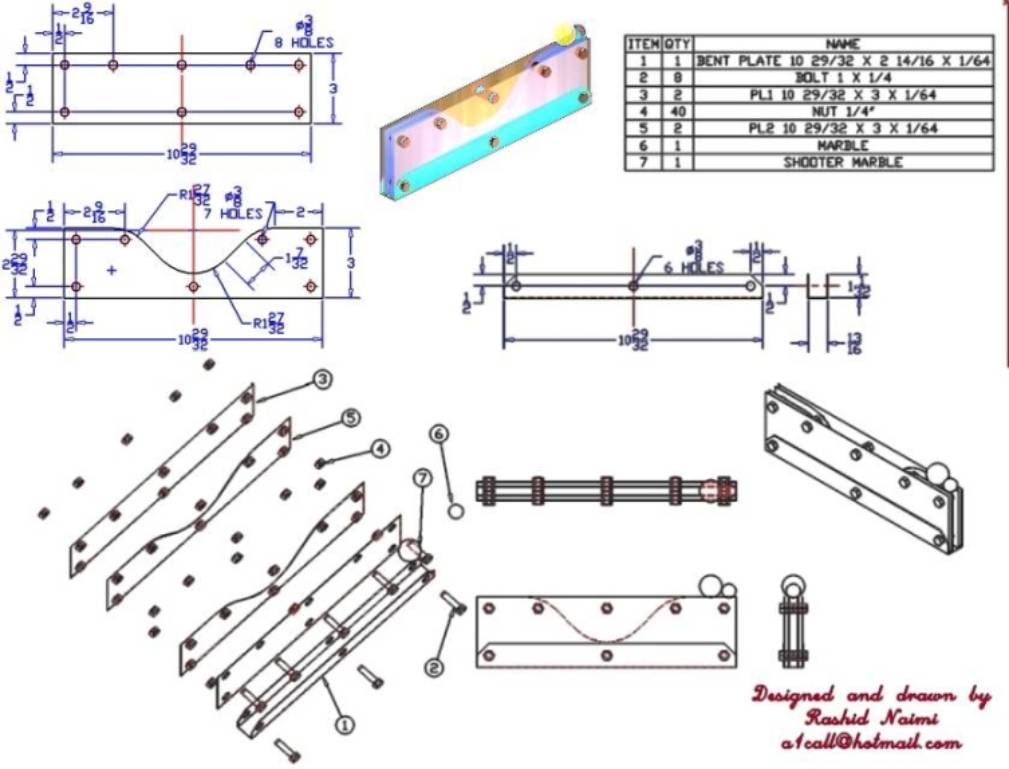
The apparatus shown in the video is fabricated according to the
following drawing. It is not designed to optimize the
presentation, rather to be easy and fast to fabricate using the
materials that I had available. The design incorporates a marble
and a shooter marble, so that it would be clear which marble finishes
first even without filming the process.
Conclusion
In conclusion I would like to state the following:
For any two points on the surface of the earth that a straight line
going through them makes an angle greater than 45° with the normal,
there exists a path faster than a straight line passing through these
points for any given thrust greater than zero and drag. This can be
achieved by substituting part of the straight path by a profile roughly
that of a right-angle angle whose two lines are at 45° to the normal.
In my opinion this principle will inevitably be incorporated in the
transportations of the future, simply because the laws of physics make
this a faster path.
In addition, the further the distance that is to be traveled, the
higher the average speed will get. Drag has the effect of limiting the
maximum speed, but this issue can be addressed through the design of
the vehicle and thrust and other techniques which can be discussed at a
later time.
This demonstrated principle can probably be best utilized in an
equivalent spring operated design as well as it's electronic
equivalent.
This principle does not violate the law of conservation of energy and
matter. It merely takes advantage of the fact that every object
on the surface of the earth has a potential energy and that its
potential energy would be the same anywhere else having the same
altitude.